
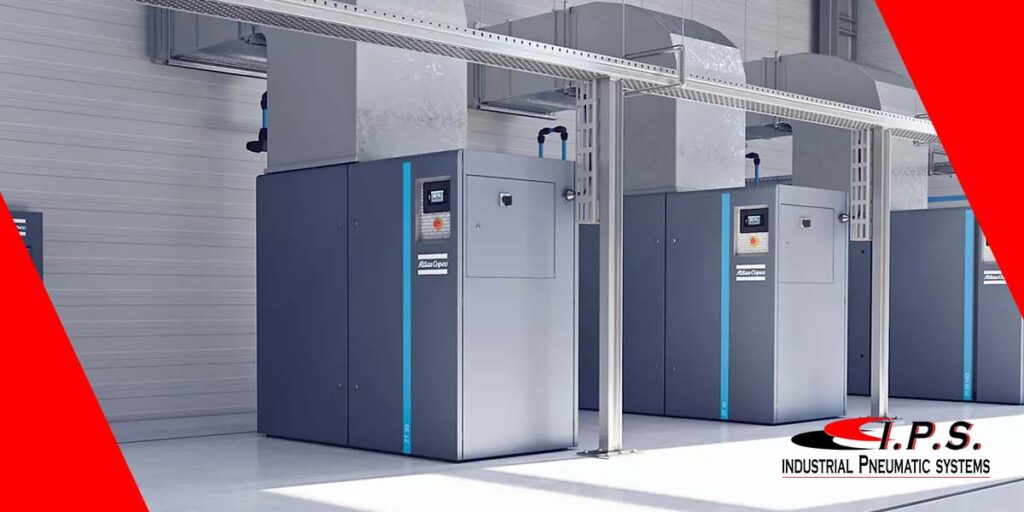
Air compressors are a critical component for multiple sectors, from health care and food production to automotive and manufacturing. When choosing your compressor system, you must consider your industry, operational efficiency needs and long-term costs.
For many facilities, oil-free air compressors offer distinct advantages over traditional, oil-lubricated models. They deliver clean air, require less maintenance and are well-suited to sensitive environments.
This guide explores the benefits of oil-free air compressors and what qualities make them a wise choice for many applications.
What Is an Oil-Free Air Compressor?
An oil-free air compressor has no oil in its compression chamber. Instead, it uses friction-reducing coatings to protect internal parts.
Modern oil-free air compressors are available in several types.
- Rotary screw compressors: Designed for continuous operation in medium to large operations.
- Scroll compressors: Ideal for smaller facilities or for intermittent use.
- Centrifugal compressors: Best for high-volume industrial operations.
Despite their name, oil-free air compressors may still contain traces of oil in some internal mechanisms. However, the compressed air remains completely oil-free.
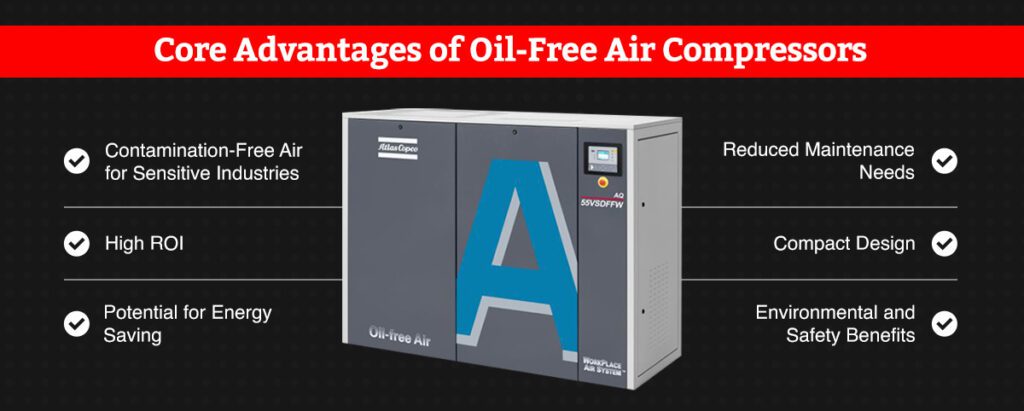
Core Advantages of Oil-Free Air Compressors
Oil-free air compressors offer several benefits that make them ideal for commercial and industrial operations. Many industries favor oil-free air compressors for their high return on investment and added environmental benefits.
Contamination-Free Air for Sensitive Industries
Even a minor contamination can compromise quality, safety or regulatory compliance in many environments. Unlike oil-lubricated systems, which risk contaminating the air stream with oil particles, oil-free compressors maintain pristine air quality.
These systems help operations meet high standards while complying with regulations and safety measures. Oil-free air compressors are especially well-suited for industries where clean air quality is a must, such as hospitals.
These sectors benefit the most from oil-free air.
- Health care: Providing clean, safe air in critical care environments supports patient safety and regulatory compliance.
- Food and beverage: Delivering contaminant-free air for packaging and processing maintains product quality and meets food safety standards.
- Pharmaceuticals: Supplying pure compressed air in laboratory settings protects sensitive products.
- Electronics and automotive manufacturing: Air without lubricant carryover prevents contamination and maintains product precision on assembly lines.
Reduced Maintenance Needs
Oil-free systems significantly reduce maintenance demands. With no oil to change, operators can save time, labor and costs of buying replacement materials. Instead, routine maintenance focuses on scheduled inspections to check for leaks and clogged filters.
This extra level of efficiency reduces downtime, ensuring your operations can continue without stopping for oil changes.
Potential for Energy Saving
Some oil-free compressors are highly energy-efficient and use less electricity to operate. Models with variable-speed drives let you adjust output to match demand, reducing energy consumption and operating costs without compromising performance. While any compressor can have this feature, the energy savings from oil-free equipment is often more noticeable due to lower resistance.
High ROI
Oil-free air compressors often have a higher up-front cost. However, the initial purchase price is only part of the story. Less labor and maintenance will result in a lower total cost of ownership than oil-lubricated alternatives, saving you money in the long run.
Compact Design
Many oil-free compressors are more compact than oil-lubricated models, simplifying installation and maximizing your floor space.
Environmental and Safety Benefits
Air that meets strict purity requirements supports safer, more environmentally responsible operations. Since they have no oil in the compression chamber, these systems reduce spill risk and hazardous waste, lowering the likelihood of workplace accidents. Following Occupational Safety and Health Administration guidelines will make your environment even more compliant and reduce risk.
From an eco-friendly perspective, fewer consumables and reduced oil waste make these systems more sustainable, aligning with many corporate goals.
Oil-Free Air Compressor Life Expectancy
The lifespan of an oil-free air compressor depends on several factors, including usage, ongoing maintenance checks and environmental conditions. However, the average oil-free system lasts around 70,000 hours, or 10 to 20 years.
Environments with continuous operation or demanding conditions naturally place more stress on compressors, while intermittent use, clean surroundings and professional upkeep can extend equipment life considerably. Because these oil‑free systems do not rely on lubricants in the compression chamber, they experience fewer contamination‑related issues and maintain steadier performance throughout their operating life.
Is an Oil-Free Air Compressor Better?
Consider your operational needs before choosing an air compression system. Understanding the differences between the two types is critical in making an informed decision.
| Air compressors: oil or oil-free? | ||
|---|---|---|
| Feature | Oil-Free | Oil-Lubricated |
| Air quality | Produces Class Zero oil-free air, ideal for sensitive industries | Air may contain oil traces, requiring additional filtration |
| Maintenance | Minimal maintenance, no oil changes | Requires regular oil changes and oil monitoring |
| Cost | Often a higher initial cost, offset by a better ROI | Often a lower initial cost, potentially weaker ROI |
| Lifespan | May have shorter compression chamber lifespan with heavy use | May have a longer lifespan, even with continuous use |
| Environmental impact | No oil waste, fewer consumables | Generates oil waste, which requires careful handling |
| Energy efficiency | Some models with VSDs can reduce energy consumption | Oil lubrication can add minor friction losses |
| Noise | Sometimes operates more loudly | Can run quietly |
Selecting the right equipment depends on your unique needs. For instance, a traditional oil-lubricated system may be a better fit if noise is a concern. Oil-lubricated systems are often more appropriate for heavy industrial environments, where continuous operation and maximum durability are the priority. However, you will need to monitor relative humidity and pressure dew point to maintain consistent air quality.
An oil-free compressor is likely a better match if air quality is a primary concern for your business and minimal maintenance checks will benefit your operation. These systems ensure continuous clean air that meets regulatory and safety standards.
Explore Industrial Pneumatic Systems’ Oil-Free Air Compressors
Oil-free air compressors are essential in workplaces that must maintain clean air conditions while maximizing performance. Whether you need a compact scroll unit or a rotary screw system for continuous operation, I.P.S. offers a full range of products to help you find the best oil-lubricated air compressor or other equipment for your needs.
Our technicians have over 100 years of combined experience in compressed air and vacuum services, ready to design and install systems that deliver reliable performance and bring you peace of mind. Reach out to our team or browse our extensive selection of oil-free air compressors to find a system that works for you.
