
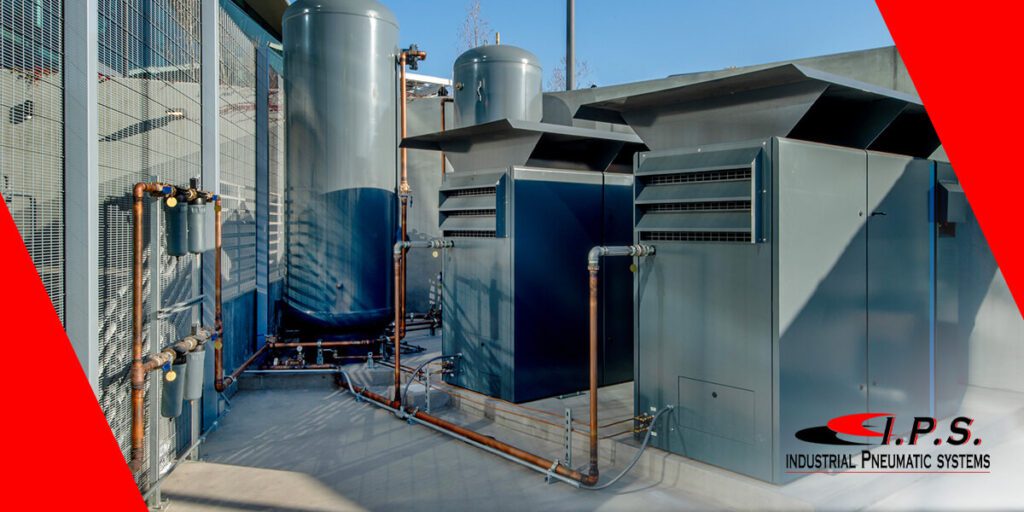
Air compressors are categorized into various systems and models. Their classifications are often based on their operating principles, performance and application. However, with the technical variety of compressors, it can be challenging to gauge how many types of air compressors there are, let alone choose one for your specific needs. Selecting the wrong type may lead to operational inefficiencies or high energy costs.
If you want to know what the different types of air compressors are, this guide explains the four most common types used in industries.
The Core Classifications of Air Compression
Before choosing a specific type of industrial air compressor, you must first understand the two core principles of air compression technology. These classifications form the foundation for how air is compressed and discharged.
Positive Displacement Compression
The positive displacement compression mechanism draws in a fixed volume of air in one or more chambers, which is then sealed from the inlet. The volume of each chamber gradually decreases, increasing the pressure and inherently compressing the air. The pressure will continue to increase until it reaches a built-in pressure ratio. Once reached, a valve or port opens. The compressed air discharges through this opening as the chamber volume continues to decrease. This mechanism delivers a consistent flow rate at high pressures.
Common industrial air compressors using positive displacement compression include:
- Reciprocating or piston
- Screw
- Scroll
- Tooth
Dynamic Compression
The blades of a fast-rotating compression impeller draw in and accelerate large volumes of air to high velocity, thereby creating pressure. The air then discharges through a diffuser. Here, the kinetic energy is converted to static pressure, ideal for high-volume applications. This is why they are also referred to as turbo compressors. The flow rate adjusts to the system’s pressure and operating speed.
Examples of dynamic compressors include:
- Centrifugal or radial
- Axial
Knowing the difference helps prevent unnecessary purchases of equipment that is ill-fitted to your facility’s scale. Under each classification, there are various subtypes of air compressors with varying designs.
4 Types of Air Compressors Used in Industry
In industrial settings, four different types of air compressors are commonly used.
1. Reciprocating Air Compressors
Reciprocating air compressors are also commonly known as piston compressors and operate on the positive displacement principle. They get their name from the crankshaft-driven piston — it moves back and forth within a cylinder to draw in and compress the air. During its downward stroke, the inlet valve opens and the chamber is filled with air. During the upward stroke, the air gets pressurized and then forced through the outlet valve.
Reciprocating air compressors have two configurations — single-stage and multistage. Single-stage compressors compress the air in one stroke, whereas multistage compressors compress the air in two or more strokes. Multistage compressors allow for higher pressure output in pounds per square inch (PSI). They are also commonly used in high-pressure applications.
The majority of reciprocating air compressors are lubricated, but oil-free versions are available. These variations use special coatings to eliminate the need for oil and, thus, make them ideal for applications that require oil-free air.
These compressors are best suited for intermittent use, typically required by workshops and smaller industrial facilities. While they are valued for their low up-front cost and simplicity, they do come with higher noise levels and heat generation.
2. Rotary Screw Air Compressors
The rotary screw air compressor uses two interlocking helical screws for its operation. Each screw rotates in the opposite direction to trap the air between them, and then compresses the air as a result. With this mechanism, it is able to continuously compress the air, instead of doing so in pulses. Rotary screw air compressors thus allow for 100% duty cycles, which are incredibly valuable for facilities that operate around the clock.
You get two types of rotary screw models. Oil-injected models inject lubricant to seal the internal gaps between the rotors. The extra lubricant helps to reduce friction and dissipate heat within. Such a model is highly efficient and provides a stable performance even under heavy loads. However, for industries where they need pure air, like pharmaceutical and food processing, the second model type is preferred. Oil-free rotary screws deliver Class 0 air. The risk of oil contamination is decreased, and compliance with strict regulatory standards is increased.
Modern rotary screw compressors incorporate variable-speed drive (VSD) technology. VSD technology allows you to match the motor’s speed to real-time air demand, helping minimize energy waste and operating costs throughout the compressor’s life cycle.
3. Scroll Compressors
Scroll air compressors use a simple orbital mechanism to compress the air. There are two spiral-shaped scrolls, one fixed and one orbiting, that trap and compress air in progressively smaller pockets. The scrolls also do not make direct metal-to-metal contact. As such, scroll compressors have minimal friction and wear, and make little noise when compared to traditional piston-shaped systems.
Because they are so quiet, scroll compressors are ideal for noise-sensitive environments. Laboratories, medical facilities, dental clinics and indoor commercial spaces all make use of scroll compressors’ benefits. For such places, low decibels may very well be just as important as reliable air delivery.
That said, while scroll compressors are quieter than reciprocating units, they typically also provide lower cubic feet per minute (CFM) output. They are not typically designed for heavy-duty, continuous industrial loads. Instead, they can be used in industrial settings for point-of-use applications.
4. Centrifugal Compressors
Centrifugal air compressors operate on the dynamic principle. They are designed for extremely high airflow and pressure in large-scale industrial environments. Centrifugal compressors do not trap air like positive displacement systems — instead, they use high-speed rotating impellers to accelerate air outward through radial airflow. The kinetic energy then converts into pressure as the air passes through diffusers and volutes.
With this design, centrifugal compressors can deliver massive volumes of compressed air with exceptional efficiency. That is what makes them the preferred solution for heavy-duty applications. If you need a high amount of horsepower and a continuous high-capacity output, centrifugal air compressors are the perfect choice. Chemical plants, power generation facilities, oil and gas operations and large manufacturers commonly use this model.
Note that these compressors do require a more sophisticated maintenance approach. Their servicing is more complex due to their aerodynamic components and tight tolerances. You will need specialized technicians to ensure your centrifugal systems perform as they should in the long term.
Selecting the Right Type of Air Compressor
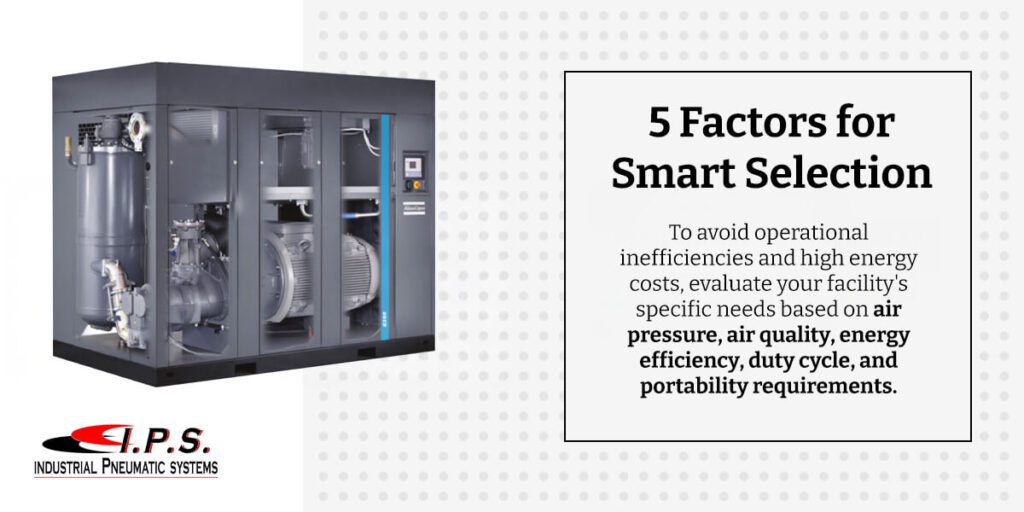
Base your decision on these five key factors:
- Air pressure and flow: You must first define the CFM and PSI needed for your tools and equipment.
- Air quality: Assess whether you will need an oil-injected or oil-free model based on your industry.
- Energy efficiency: Energy is a major factor, especially if you plan to operate the compressor continuously.
- Duty cycle: You must evaluate how often and how long the compressor will run.
- Portability: Determine if the compressor must remain stationary or be portable based on your applications.
Secure the Right Types of Air Compressors at Industrial Pneumatic Systems
By now, you know whether your operation needs the heavy-duty stamina of a centrifugal unit or the versatile efficiency of a VSD rotary screw. However, the selection process is only the first phase. Complex technology requires expert integration. Industrial Pneumatic Systems can be your full-service system architects.
I.P.S. is a full-service compressor company, meaning, when you choose us, you have access to a wide range of air compressor solutions. With compressor units and parts from major brands, like Atlas Copco®, and several services done by expert technicians, we are equipped to help you with all your air compressor needs.
Complete our online form for further assistance in making your decision.